I just put on the finishing touches 10 minutes ago, decided not to clean my kitchen for the photo shoot, and now see that I tied my back ribbons very unevenly. Looks like something frozen is for dinner.
So here it is - my finished apron. I love the way it turned out. I am working on another one in green gingham for a class that I am teaching at church so I will post pics of that by the end of the month.
First tackle the tie (piece 9). Make a 5/8" narrow hem just like before on the two long edges and the pointed edge (leave small flat edge alone) This can get a bit tricky around the point so you may need to either clip out some excess fabric or tuck some of it in while sewing.
This is what it should look like for both ties: Now attach the ties to the waistband. Fold the two ties - wrong sides together - in half along foldline. Match the symbols of the waistband to the symbols of the tie (or just line them up with the end) Pin in place. The ties will be pointing towards the inside of the apron at this time. Fold the waistband right sides together so that it is now covering the ties. Pin in place. Stitch just to the outside of the front of the apron's sewn edge.
Trim the seam allowance down. Flip and press.
The pattern suggests slipstitching the back edge down at this point. Instead I just edgestitched all the way around the waistband so that it matched all of the narrow hemming on the rest of the apron.
In my book there is a much easier way to do step 29. Instead of covering Band 6 entirely with interfacing and then measuring and turning in your 5/8 inch seam allowance, I like to trim off 5/8 inch from the interfacing on the edge that I will be turning in. Then I adhere my interfacing to the fabric. I now have the perfect edge to turn my fabric from. The fabric naturally eases in the fullness as you press over the edge as it is now just a single layer.
1. trim interfacing 2. adhere interfacing to wrong side of fabric
3. turn in seam allowance along interfacing edge
Now you are ready to pin the Band facings to the bands on front, making sure that your straps are out of the way. I sometimes pin my straps several times just to make sure they are in the clear of that side seam.
Next thing I did was make a 5/8" narrow hem up both sides of the apron - including the front and flounce. You do it the exact same way as the bottom of the flounce except without the curves. It does get a little tricky at the seam between the flounce and front just to warn you.
Here is how the back looks now:
This is what your apron should look like now:
Attach your fusible interfacing to piece 16 and press up 5/8" on the long side of the waistband without the notches (I kept it pinned because the interfacing makes it come unfolded)
Then pin right sides together so that the notched edge is at the top. The edges will hang off a bit on both sides. Stitch at 5/8". The back of your apron should now look like this:
Press the stitched seam upwards towards the waistband. The front should now look like this:
Pinning Band 6 to the front of your apron can be a little tricky as the two pieces curve in the opposite direction. The simple solution is to clip your apron front before you start pinning. I clipped every inch and a half or so all along the side edge, going only as far as the staystitching from step 24. I was then able to easily pin and sew Band 6 on, flip it, and press.
"What an awesome idea! I just found your blog and have not yet participated in a sew along, but I think I need to make this dress."
She will be the owner of the beautiful retro fabric and the maxi dress pattern. As a result she will also be a guest blogger on presserfoot for the month of September.
I already checked out her blog and etsy shop and am so excited for you all to get to know her better as well! She is very talented.
What I love most about this idea, besides the unlimited creativity and usefulness, is that you can use up your little and bitty scraps of fabric. Linda is the mastermind behind the Craft Apple. She also designs patterns and has an etsy shop. For a complete picture tutorial on making patchwork cards go here. Have a great idea for using scrap fabric? Email us at dearpresserfoot.com. We'd love to feature our readers and their blog. Share the love.
Each month you can look forward to a few post mainstays. Earlier this month we introduced OLD THINGS MADE NEW, a monthly post that will focus on reusing items you probably already have. You know, going green kind of stuff. But reinventing old items isn't the only thing we can do to help save the earth and our wallets. What about all the little scraps of fabric after every project? The bits that go right from my serger tray into the trash or the odd shaped pieces left from in between two pattern pieces. Every month we will also carry a post called WITH SCRAPS. In this post we will do exactly that, find clever ways to use up the leftovers.
This month's great idea comes from the Creative Chicks just in time for school. Selvage edges of fabric + a little backing fabric + an exposed zipper = a pencil holder for school. So much cuter and more durable than the plastic ones, plus it's free! If you've made an old thing new or have a great idea for using scrap fabric we'd love to feature you and your blog. Just email us pictures and information or a link to your blog showing what you've done to dearpresserfoot@gmail.com. Share the love.
Speaking of love, have you signed up for this month's giveaway yet? Click here.
I know, it's a nice problem to have. I owe it all to my handsome husband who surprised me with my sewing machine and serger for a college graduation gift. Many years later I am still known at the shop where he bought them as, "oh, you're the one who's cute hubbie came in and bought them for you. You know he asked so many questions he wanted to get just the right one." I know, he's a nice husband to have.
I love my serger. It's quick, clean, awesome. So one might ask why then did I spend my evening waiting for said hubbie to come home at the ironing board measuring, folding and pressing a narrow hem? (click here for a great picture tutorial by Kelli on making a narrow hem) As you can see in the picture I did use my serger on some parts, in particular parts that are 1. not seen and 2. not in a high friction area. The flounce and sides of the apron simply lay flat on your body, but the neck and waist ties will be pulled, knotted, bowed, and adjusted over and over again. I fear the interlocking thread would not hold up over time with such abrasion, while the narrow hem has the raw edge neatly tucked inside for optimum durability. And besides, I think it looks nicer. Got to have a little apron pride.
Good news. I was at Joanne Fabrics the other day and noticed that they have made a see n' sew version of the apron pattern we are working on this month - B5125.
After closer inspection I realized that it is exactly the same - with only two apron options instead of four. So if you missed the sale you can always get the pattern for $2.99.
So now there are no excuses to not whip up one of these cute aprons.
Don't forget to enter our giveaway. Click here for the giveaway post.
Attaching the flounce is exactly the same from view D to E, but after that we go our separate ways. With view D we have our V cut collar line that is made by cutting a small piece of fabric with interfacing fused on to match the same lines, sewing them right sides together and then flipping the interfacing over to create a seamless look on the front of your apron. The instructions describe this pretty well as long as you under stand what UNDERSTITCHING is. Understitching attaches the raw edge to the layers of interfacing. In the photo above you will see that the main body of my apron in out to the left, while the interfacing is under the presser foot to the left with the raw edges laying on top. Simply sew a straight line down the middle of the raw edge to attach the two. Note: No stitching will appear on the front, main body of the apron. Images below show the front and back view of the apron after the understitching is complete. Any questions? And don't forget to enter this month's give away! It's just one post away (below)!
First of all Rian and I decided that we are going to start announcing next month's pattern earlier so that you have plenty of time to plan. So, next months pattern is Simplicity 2638 - the oh so popular maxi dress. I feel like maxi dresses are everywhere and look good on anyone so I am super excited to get started.
Now for the giveaway part of the post. Rian and I are starting something new on this blog as well - a monthly giveaway.
Here is how it works:
What presserfoot will do:
we will provide you with next month's pattern
we will provide you with some awesome fabric to make the pattern
we will do a short feature on our blog about you and your blog (if you have one)
What we ask of you:
we ask that you make the pattern in the month given with the fabric
we ask that you be an author on our blog for that month and make at least 4 posts during the month about your experience making the pattern.
you will need to get your own notions, interfacing etc...
Pretty great deal right? Well, to enter for this month's giveaway for the maxi dress pattern and fun fabric below (it's cotton voile from Vogue fabrics) just comment on this post. Make sure that you have either your email or blog url on there so that we can contact you. It will be open until next Saturday the 22nd until midnight.
I hope you guys are as excited about this as we are!
In an effort to save Mother Earth each month we will share one way we can make an existing object new for you. We all have piles of fabric and notions that we loved at one point or somehow became bequeathed to us. Maybe you fell out of love or never liked it in the first place, but don't throw it way, reinvent it or give it way. This month's apron project would also make a great gift in a fabric that, maybe not you, but someone else would love. Reuse!
One Summer afternoon a neighbor offered me about 300 lbs of brand new, but defective, Levi jeans. He was just going to throw them away! I had no idea what I would make of them, but I knew they had great potential, and I could always fall back on 100 jean blankets (Merry Christmas everybody!). I have yet to make a jean blanket out of them, and have hardly made a dent in my inventory, but I have made quite a few things (including, but not limited to: hand bags, patches, appliques, and kid aprons).
Making kid's aprons out of jean is simple, quick, and inexpensive. Cost: $1.50 Time: 20 minutes
1. cut up the inseam of one pant leg and then up through the back seam so it opens and lays flat. 2. I laid one of my daughter's existing aprons over the jeans and traced it with a permanent maker. 3. cut it out 4. using your desired thickness of double fold bias tape (it comes in many different colors), cover the edges by inserting the edge of the jean into the fold of the tape. Make sure to leave an opening for your child's head. 5. sew the tape on 6. decorate as desired. we used a little fabric paint to add the child's first name initial and then did a little infer painting at the bottom for our preschool princess project. I have made then for boys as well.
Now that the pocket it attached to the front piece it is time to tackle the flouce (pretty little ruffle on the bottom of the apron).
First I staystitched the upper edge of the flounce. Staystitching - Sew a stitch line just inside (1/8") of the normal seam allowance. Since a normal seam allowance is usually 5/8" from the raw edge, then the staystitch line is usually 1/2" from the raw edge. This stitch is usually called for on curved or bias cut edges and will give extra reinforcement to prevent it from becoming stretched or distorted. Then I made a 5/8" narrow hem on the bottom edge of the flounce. If you have a serger then you don't have to do a narrow hem. Just serg and turn under. But I think the narrow hem looks really sharp. And get use to it because you will be doing a lot of it on this apron.
Narrow Hem - A hemming method where you fold the raw edge at 5/8" and press. Open and fold again so that raw edge is along crease. Press. Fold again on the crease and stitch.
This can be a little confusing so here are the step by step pics:
1- Press up 5/8" from raw edge Ease in fullness if necessary.
2- Open and press raw edge into the crease previously formed . The fold will now be half as wide. 3- Fold and Press one more time along crease line. You will no longer be able to see the raw edge. 4- Stitch just inside of the hem - about 1/4" from edge. Here is how the finished hem should look. Lastly, simply attach the top edge of the flounce to the bottom edge of the front panel (which has the pocket on it) with a 5/8" seam. You will need to clip the flounce edge so that it will curve correctly. Only stitch to within 3/8" of both outside edges. The flounce is attached!
I have a bad habit of losing my cell phone in my apron pockets. And yes, I do already have a few aprons, but they serve completely different purposes (i.e. keeping the dirt off while gardening, some place to dry my hands while cooking, and as a splinter barrier while crafting). So, in order to have a place to store and lose my cell phone in this lovely lemon apron I am going to fore go the ribbon bow and add the pocket from pattern E in the contrasting fabric.
By the way, for the first time ever I have lost my cell phone charger, so please don't call me, I can't answer. Happy cell phone hunting.
After cutting out your fabric the first step is to make the pocket. I hate making pockets, I think they are much more complicated than they need to be. So, I am going to show you how I simplified the pocket procedure.
First I cut out two (instead of the designated one) pocket pieces.
Sew both pieces together at a 5/8" seam allowance with right sides together - leave an opening in one side about 2" wide so that you can turn it right side out.
Trim seam allowance and clip notches out of the corners so that it will bend smoothly once turned. Turn pocket right side out and press. (Press opening closed so that it matches up with the other seam edges) Position pocket on front piece of apron. The pattern has markings for this - I, however, decided that I wanted the fabric design to match up so I positioned it a bit higher and more upright than the pattern suggested.
Pin in place. Edge stitch around the two sides and bottom of the pocket. Press and it is done. (Much easier than the way the instructions suggest)
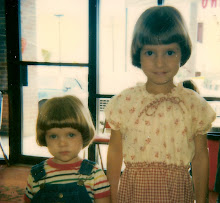
we started out with the same parents, then the same Dorothy Hamill hair cut, same room for 13 years, fights over the same love of a belt, and now many miles and even states apart we share our same love of sewing with you. -Kelli (overalls) & Rian (buck teeth)
Show It Off
Want this button for your blog/website? Just copy & paste the following code:
Mad Men Sew-Along Button
Want this button for your blog/website? Just copy & paste the following code:


 Posts
Posts


 Trim the seam allowance down.


 Have a great idea for using scrap fabric? Email us at dearpresserfoot.com. We'd love to feature our readers and their blog. Share the love.


 I feel like maxi dresses are everywhere and look good on anyone so I am super excited to get started.


 By the way, for the first time ever I have lost my cell phone charger, so please don't call me, I can't answer. Happy cell phone hunting.